Middlesex County & Massachusetts Disposal Rules | LWL
Massachusetts' MassDEP Waste Ban list controls what can legally go in a rented dumpster in Middlesex County, and getting it wrong can mean rejected loads or extra fees.
ReadLowell, MA guide
Massachusetts law requires a Dig Safe call at least 72 business hours before any excavation, and this guide explains exactly which Lowell-area dumpster projects trigger that rule and which don't.
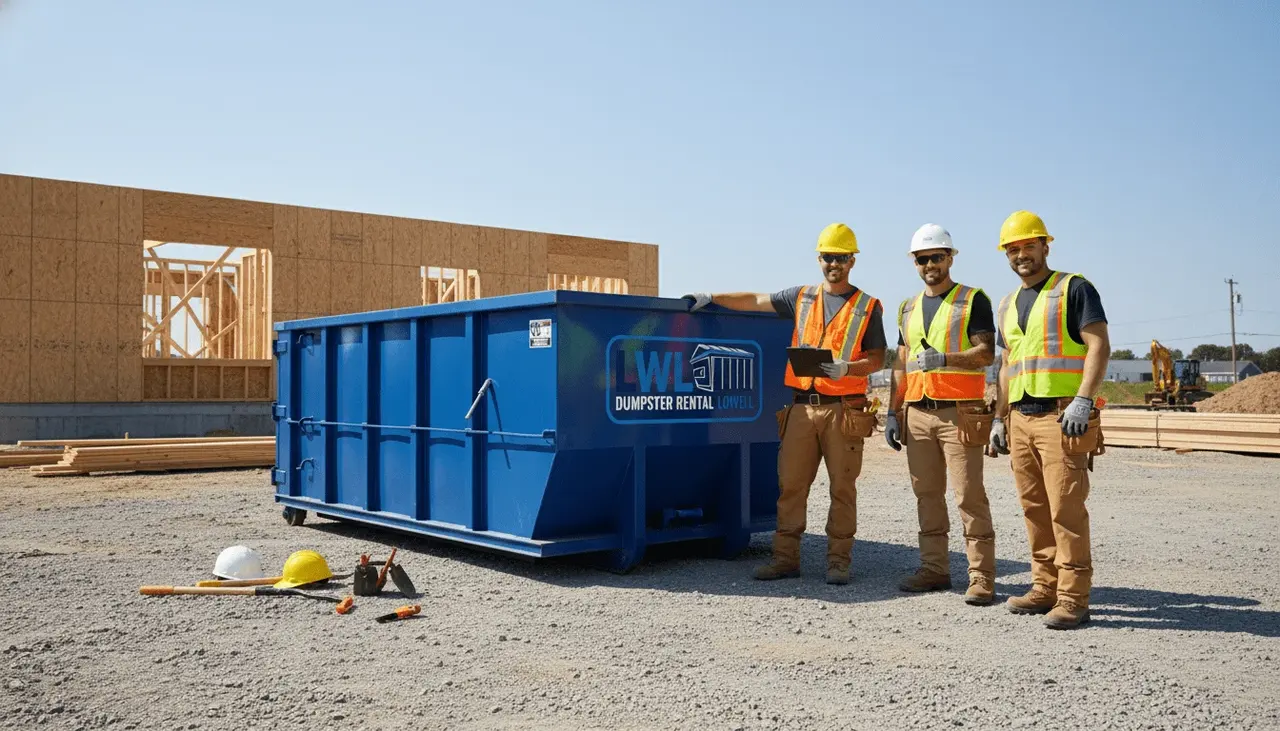
Most dumpster rentals in Lowell never touch a shovel. A roll-off lands on an existing driveway on Fairmount Street, gets filled with attic junk or roofing tear-off, and rolls back out a week later. No permit issue, no utility issue, nothing under the surface ever gets disturbed. But a fair number of the jobs that call LWL Dumpster Rental aren't quite that simple. A homeowner in Belvidere replacing a fence line, a contractor pouring new deck footings in Pawtucketville, or a crew regrading a driveway off Bridge Street in Centralville are all doing something the dumpster rental itself doesn't do: breaking ground. That's the moment Massachusetts law requires a different phone call before the first shovel goes in — to Dig Safe.
This guide walks through what Dig Safe System, Inc. actually is, the real state law and regulation behind it, the true 72-hour notice window, and — most importantly for anyone renting a dumpster — which parts of a typical Lowell or Middlesex County cleanout, remodel, or construction project actually require a locate, and which don't.
Dig Safe System, Inc. is the nonprofit "one-call" notification center for Massachusetts, along with Maine, New Hampshire, Rhode Island, and Vermont. It isn't a private locating company and it doesn't send anyone out to dig or inspect your project. What it does is much narrower and more important: when you call 811 or 1-888-DIG-SAFE (that's 1-888-344-7233), or file a ticket online at digsafe.com, Dig Safe relays your excavation location to every member utility company that has underground gas, electric, water, sewer, or communications lines in that area. Each of those utilities is then responsible for sending someone to mark their own lines with flags or spray paint before you're legally cleared to dig.
One call covers every member utility at once, which is the entire point of the system — instead of a homeowner in the Acre trying to separately track down the gas company, the electric company, and the cable provider, one ticket routes the request to all of them.
Dig Safe isn't a courtesy program or an industry best practice — it's Massachusetts state law. The requirement to notify before excavating is written into Massachusetts General Laws Chapter 82, Sections 40 through 40E, with the day-to-day procedural detail spelled out in 220 CMR 99.00, the Department of Public Utilities' Dig Safe regulation. Together, the statute and the regulation define what counts as excavation, who has to call, how much advance notice is required, and what happens if someone doesn't call. The law applies broadly — it doesn't carve out an exception for homeowners doing their own weekend project instead of hiring a licensed excavation contractor. If you're the one putting a shovel, auger, or trencher into the ground, the notification obligation is generally on you, same as it would be on a paving company or utility crew.
The statute's definition of excavation is intentionally broad: essentially any activity that disturbs the earth, including grading, trenching, boring, and driving in posts or stakes below a certain depth. That's a wider net than most people expect, which is exactly why fence posts and mailbox installs show up on the "yes, call first" side of the ledger below. The Commonwealth's own summary of the requirement, published by the Department of Public Utilities, is a useful plain-language reference alongside the statute itself — see Mass.gov's Dig Safe guide.
The number most Lowell homeowners and contractors have heard is "72 hours," but the detail that trips people up is that these are business hours, not calendar hours. Massachusetts law requires notice at least 72 hours in advance, excluding Saturdays, Sundays, and legal holidays — and no more than 30 days before the planned excavation date. In practice, that means a ticket called in Monday morning is typically clear to dig by Thursday morning, but a ticket called in on a Friday doesn't finish its 72 business hours until partway into the following week, since the weekend doesn't count.
Once your ticket is submitted, member utilities have until it becomes valid — that 72-business-hour mark — to get their locators out and mark their lines, generally accurate to within about 18 inches of the actual line. The ticket itself stays valid for 30 days, which matters if a Lowell project gets delayed by weather or a permit hold-up covered in our street placement and permit guide. Before you even call, Massachusetts practice asks you to pre-mark the dig area yourself with white paint, stakes, or flags, so the locators know exactly where to focus.
Here's the part that actually matters for most people booking a roll-off from LWL: setting a dumpster down does not, by itself, disturb the earth. A 20-yard or 30-yard container sitting on an existing paved driveway, a parking pad, or even an established lawn isn't excavation — nothing is being dug, bored, or driven into the ground. The obligation to call Dig Safe is tied to digging, not to placing something heavy on a surface that already exists.
Where it gets confusing is that a lot of the projects people rent dumpsters for also involve some amount of digging somewhere else on the same property — and that separate work needs its own Dig Safe ticket, timed 72 business hours ahead, regardless of when the dumpster shows up. The table below breaks down common Lowell-area, dumpster-adjacent scenarios.
| Project or Situation | Dig Safe Call Needed? | Why |
|---|---|---|
| Dumpster placed on an existing driveway or paved area | No | Nothing below the surface is disturbed by set-down |
| Dumpster placed on an established lawn, no digging planned | No | Weight on the surface isn't excavation |
| New driveway installation or regrading | Yes | Grading and sub-base work disturb the earth |
| Fence post holes, even by hand auger | Yes | Post holes count as excavation under state law |
| Deck footings or concrete sonotube piers | Yes | Below-grade digging near utility corridors |
| Mailbox post replacement | Yes | Even shallow, small-diameter holes require a locate |
| Tree or stump removal with root-ball digging | Yes | Root removal disturbs the surface of the earth |
| Shed or garage teardown that includes slab or footing removal | Yes | Breaking up and removing below-grade concrete is excavation |
| Loading interior renovation debris (drywall, cabinets, flooring) into the bin | No | No ground disturbance, only material handling |
If any row on the "yes" side applies to your project — say, a demolition that includes pulling an old slab, or a construction job with new footings — the digging portion needs its own Dig Safe ticket even though the dumpster portion doesn't. Plan the locate around your actual excavation date, not around your delivery date, and coordinate both with LWL so the bin is on-site and ready once you're cleared to break ground.
Skipping Dig Safe isn't a paperwork risk — it's a real one. Under Section 40E of the statute, violators can face fines starting at $1,000 for a first offense and running from $5,000 up to $10,000 for a repeat offense within a 12-month period, on top of being financially responsible for the cost of repairing whatever line was hit. A severed gas line can mean an evacuated block and a service call from the fire department; a cut fiber line can knock out internet for an entire section of a neighborhood; a nicked water main can flood a job site and erase days from a project's timeline. None of that is hypothetical — utility strikes are the single most common reason otherwise straightforward excavation jobs in Middlesex County turn into expensive, drawn-out problems.
There's also a simple insurance angle worth knowing: if you didn't have a valid Dig Safe ticket for the excavation that caused the damage, most contractors' and homeowners' policies are far less likely to cover the resulting claim cleanly, since the incident stemmed from a legal requirement that wasn't met.
Lowell earned the nickname Mill City for a reason, and that history sits underground as much as it does in the brick mill buildings along the Merrimack and the Pawtucket Canal. Neighborhoods like Downtown, the Acre, and Centralville have some of the oldest utility infrastructure in Middlesex County — water and gas mains that predate modern mapping standards, and service lines that have been added, rerouted, or patched over more than a century of use. Older infrastructure doesn't make a Dig Safe call less important; if anything, it makes the locate more valuable, since as-built records for a 19th-century mill lot are far less reliable than for a subdivision built in the 2000s. The same logic applies to properties near the historic mill complexes covered in our mill building renovation debris guide — dense, layered utility corridors are common near the old mill footprint, and a locate crew is the only way to know what's actually down there before a footing or post hole goes in.
The cleanest way to run a Lowell project that involves both a dumpster and some digging is to treat them as two separate timelines that meet in the middle. First, if any part of the job — a fence, a deck, a driveway, a demolition with footing removal — involves breaking ground, call 811 or file online at digsafe.com at least 72 business hours before the planned dig date, and pre-mark the area with white paint or flags first. Second, once your locate is confirmed and the lines are marked, call LWL at (978) 848-1596 to schedule delivery so the bin arrives right when you're ready to start hauling debris, positioned on pavement or an already-cleared area rather than on top of freshly marked ground. If you're not sure which size container fits the scope of the work, our team can help size it over the phone based on the type of debris and how much digging or demo is involved.
Keep the utility markings visible and intact for the length of the project — they're only good until they fade, get paved over, or the 30-day ticket expires, whichever comes first. If the project stretches past that window, a fresh ticket is a quick call, and it's a far better use of a few minutes than guessing what's still buried under a Lowell backyard. For a state-by-state look at how Massachusetts' one-call program compares to neighboring states (useful if a job straddles the New Hampshire line), the national 811 Before You Dig directory keeps a current summary.
The dumpster is almost never the part of a Lowell project that needs a Dig Safe call — the digging is. Know which side of that line your project falls on, call 811 at least 72 business hours ahead of any excavation, and let LWL handle the container end of the job. Between the street placement rules, what a rental actually costs, and now the Dig Safe timeline, that covers the three questions that come up on nearly every residential or concrete and heavy debris job we deliver to in Middlesex County. Questions about timing a delivery around a locate? Contact LWL and we'll help you sequence it.
Talk to a real person
Call and describe the job. Flat price, stated tonnage, and a delivery time on the same call.
Mon–Sat 7:00am – 7:00pm
From this guide
No. Setting a roll-off dumpster on an existing driveway, paved area, or established lawn doesn't disturb the ground, so it doesn't trigger the Dig Safe requirement on its own. The call is only required if the same project also involves excavation, such as a fence, deck footings, or a new driveway.
At least 72 hours in advance, excluding Saturdays, Sundays, and legal holidays, and no more than 30 days before the planned excavation date. A ticket called Monday morning is typically clear by Thursday, while one called Friday won't clear until midweek because the weekend doesn't count toward the 72 hours.
Call 811 or 1-888-DIG-SAFE (1-888-344-7233), or file a request online at digsafe.com. Dig Safe System, Inc. is the single one-call center covering Massachusetts, Maine, New Hampshire, Rhode Island, and Vermont, so one ticket notifies every member utility with lines near your address.
Under Massachusetts General Laws Chapter 82, Section 40E, penalties start at $1,000 for a first offense and run from $5,000 to $10,000 for a repeat offense within 12 months, plus you're financially responsible for repairing any utility line that's damaged. A struck gas or water line can also shut down a job site and the surrounding block for hours or days.
No. Dig Safe only notifies member public utility companies covering gas, electric, water, sewer, and communications lines. Private lines on your own property, such as irrigation systems, invisible pet fencing, or a private well line, need a separate private locating service before you dig near them.
Keep reading
Massachusetts' MassDEP Waste Ban list controls what can legally go in a rented dumpster in Middlesex County, and getting it wrong can mean rejected loads or extra fees.
ReadIn Lowell, a dumpster kept entirely on private property usually needs no permit, but placing one in the street or public right-of-way generally requires the City's sign-off — here's how to tell which situation you're in.
ReadA practical guide for Lowell landlords and property managers on clearing out apartments and triple-deckers between tenants, from the May/August student turnover crunch to sizing, permits, and disposal rules.
Read