
Estate Cleanout Checklist for Lowell, MA Families | LWL
A practical, step-by-step checklist to help Lowell-area families clear a loved one's home at a pace that respects both the timeline and the memories involved.
ReadLowell, MA guide
A practical guide to sorting storm and yard debris from construction debris under Massachusetts disposal rules, and sizing a roll-off dumpster for storm cleanup across Greater Lowell and southern New Hampshire.
Between a late-fall nor'easter and the last heavy wet snow of a Massachusetts spring, most years bring at least one storm strong enough to take down limbs, snap weak branches, and leave a yard covered in debris from Lowell out through the rest of Middlesex County. Neighborhoods with mature tree canopy — Belvidere, Pawtucketville, and the Highlands among them — tend to see the heaviest limb drop, but the same pattern plays out across the wider service area: Chelmsford, Dracut, Tewksbury, Westford, Tyngsborough, and Billerica to the south and east, Pepperell, Groton, Dunstable, Ayer, and Littleton to the northwest, and just over the state line in Pelham, Hudson, Nashua, Windham, Salem, and Londonderry, New Hampshire. Wind and ice damage doesn't respect town lines, and neither does the cleanup that follows.
The National Weather Service's Boston/Norton forecast office, which covers the Merrimack Valley, tracks the region's winter nor'easters and the heavy, wet snow that comes with a coastal storm track — the kind of snow load that snaps branches a drier powder snow wouldn't touch. Add an ice storm or a summer microburst to the mix and a single weekend can leave a property with more brush, broken fencing, and roof debris than a normal trash pickup or a few trips to the transfer station can handle. That's usually when a homeowner starts pricing out a dumpster — and where the details in this guide start to matter.
Most of the region's storm risk clusters into two stretches of the year: a fall-through- spring window of nor'easters and ice storms roughly November through April, and a shorter summer window where a fast-moving thunderstorm or a downburst can drop as many limbs in twenty minutes as a whole winter storm does over a weekend. Lowell's older neighborhoods, especially streets closest to the Pawtucket Canal and the Merrimack River, carry a lot of mature tree canopy that dates back decades — part of what makes the city's historic districts attractive, and part of why those same blocks tend to see more limb and branch damage than newer, more sparsely planted subdivisions further out toward Groton or Littleton.
It's tempting to treat "storm cleanup" as one big pile, but Massachusetts disposal rules draw a real line between yard debris and construction & demolition (C&D) debris, and that line matters for where a load can legally go. MassDEP's waste disposal ban list keeps a number of material categories, including yard waste and C&D debris, out of the regular solid-waste stream and routes them to facilities set up to handle each one. Leaves, brush, and small branches are yard waste. Storm-broken fence panels, torn-off roofing and gutters, water-damaged drywall from a roof leak, and snapped deck boards are C&D debris — the same category MassDEP's construction and demolition materials guidance covers for an actual construction or demolition project. Mixed together in one load without a heads-up, a transfer station can reject it or bill it at a higher C&D rate. Our own Middlesex County landfill and recycling guide goes deeper into where each material stream actually ends up locally.
In practice, most storm cleanups end up as a mixed load anyway — a downed limb and a smashed section of fence rarely arrive separately — and a roll-off dumpster is built to take that mix. The distinction matters most for volume you could keep out of the dumpster altogether: many towns in the service area run their own curbside brush pickup or a free yard-waste drop-off after a major storm, and diverting straight brush there frees up dumpster capacity for everything else. Worth a quick call to your town's DPW before you order, since that free option isn't available everywhere or year-round.
Here's how the most common storm materials break down between the two streams, and what to know about each before you start loading a container.
| Debris Type | Which Stream | What to Know |
|---|---|---|
| Leaves, needles, grass clippings | Yard waste | Banned from regular disposal in Massachusetts — check for a town compost drop-off before it goes in the dumpster. |
| Brush and small branches (under ~4″ diameter) | Yard waste | Fine in a roll-off for volume; some towns want it separated curbside for chipping instead. |
| Cut rounds and limbs from larger trees | Yard waste / bulky wood | Loads into a dumpster without trouble; a whole downed trunk usually needs a tree service to section first. |
| Storm-damaged fencing, decking, lattice | C&D debris | Treated or painted lumber counts as construction debris, not yard waste. |
| Roofing shingles, flashing, torn gutters | C&D debris | Same category as a planned roofing tear-off — see our roofing dumpster sizing guide. |
| Water-damaged drywall, insulation, flooring | C&D debris | Comes out of interior leak repair, not yard debris — keep it out of a yard-waste-only stream. |
| Mixed loads (branches, fence panels, shingles together) | Mixed C&D | Most storm cleanups land here — just mention it when you book so we bring the right container. |
Storm debris is bulkier and less predictable than a typical remodel load, so sizing runs a little differently than it does for a straightforward project. Our general dumpster size guide covers the basics; here's how it applies specifically after a storm.
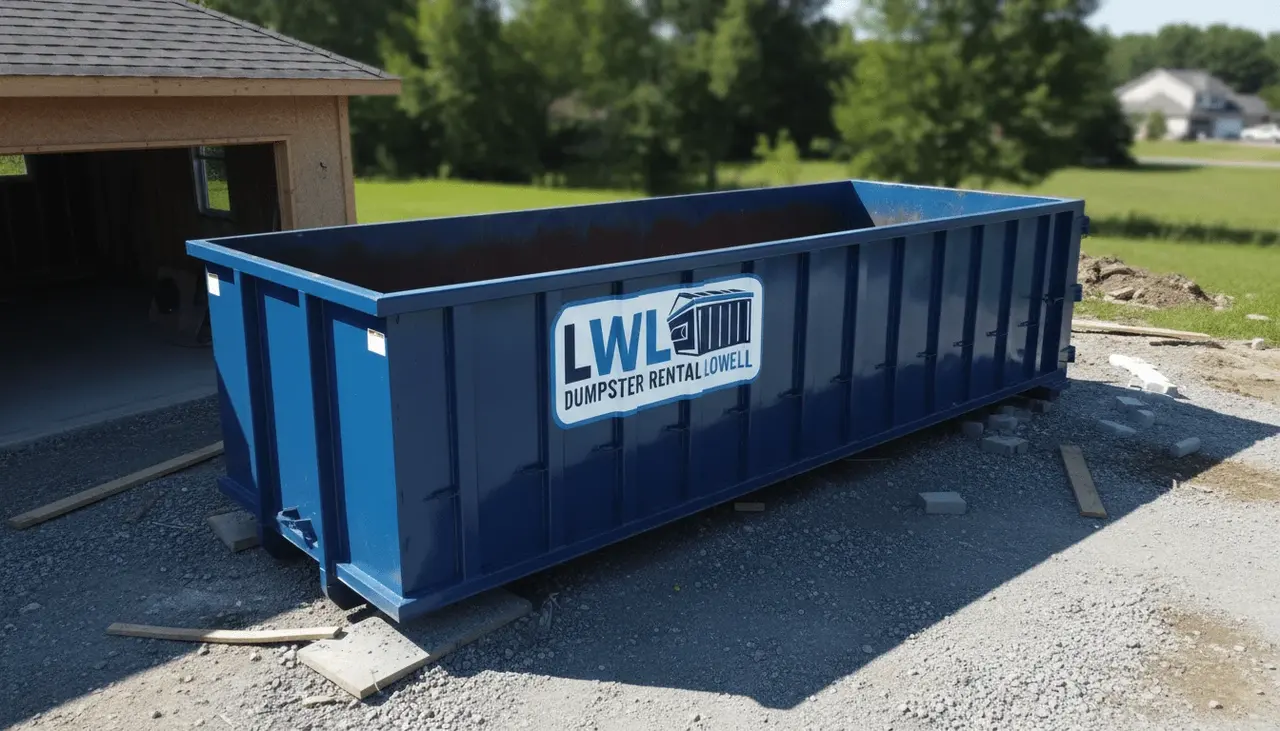
A 15-yard container usually covers a single downed tree or a couple of large limbs on an average residential lot — enough brush and cut wood to fill a pickup bed several times over, without paying for space you won't use. A 20-yard is the most common call after a real storm: multiple trees down, a stretch of damaged fence, and some general yard cleanup on top of it. For larger properties, several mature trees down at once, or storm damage combined with a bigger job like a partial roof tear-off, a 30-yard gives enough room to avoid a second delivery mid-cleanup. Our 20-yard dumpster page breaks down dimensions and typical uses in more detail, and the same logic applies whether the property is a single-family lot in Belvidere or a larger parcel out toward Ayer or Pepperell — more downed trees and more damaged structure both push the sizing conversation up, not the town.
One thing that catches people off guard: wet storm debris is heavy. A dumpster's weight limit, not its visible fill line, is often what actually caps a storm-cleanup load — rain-soaked branches and waterlogged fence sections weigh a lot more than the same volume of dry construction debris. If a yard has a large volume of green wood and wet brush, it can sometimes make more sense to order a size up, or to split a big cleanup across two smaller pickups, purely to stay under the weight limit rather than the volume limit. Mention the scope when you call and we'll size it around both.
After a bad storm, driveways are sometimes blocked by the very debris that needs hauling away, which pushes more containers than usual onto the street. Lowell, like most Massachusetts cities, requires a permit to place a dumpster on a public street rather than on private property — our street placement permit guide walks through when that applies and how to get one sorted quickly. If there's any question about where a container can legally sit during an active cleanup, it's worth asking when you call rather than guessing.
Timing is the other practical factor: dumpster demand spikes hard in the days right after a significant storm, across the whole Merrimack Valley and into southern New Hampshire at the same time. Ordering early in a cleanup, rather than waiting until debris is fully sorted and piled, usually gets a container on the property faster.
It's also worth checking whether your town is running a temporary curbside brush collection in the days after a major storm — several communities in the service area do this following larger events, on a schedule separate from normal yard-waste pickup. Where that's available, it's a free way to move straight brush and small limbs off the property without using dumpster capacity, leaving the container for fencing, roofing, and everything else that doesn't qualify for a municipal brush pickup.
Downed power lines are the real hazard in most storm cleanups, and the safest assumption is that every line on the ground is live until a utility crew confirms otherwise — even one that looks dead, or one tangled in a fallen branch. Keep people, pets, and equipment well away from it and call the utility company directly rather than attempting to move it yourself.
If any part of the cleanup involves digging — resetting a fence post, replacing a mailbox post, or repairing storm-damaged landscaping — Massachusetts law requires a Dig Safe locate first, the same as it would for a planned project. Our Dig Safe guide covers how the 811 call-before-you-dig process works. Beyond that, basic chainsaw and loading safety still applies after a storm: gloves, eye protection, sturdy footwear on a yard that's likely still wet or icy, and loading heavier limbs and cut rounds low in the container rather than stacking everything on top of lighter brush. If a large limb or an entire tree is hung up in another tree's canopy rather than fully down, that's a job for a tree service with the right rigging, not a homeowner with a chainsaw — the debris underneath it can wait until it's safely on the ground.
Sometimes a storm does more than take down a few branches. Wind can strip a section of roofing or siding outright, in which case the debris and the sizing questions look more like a planned roof tear-off, covered in more detail in the roofing guide linked above. Commercial properties aren't exempt either — a strip mall or office lot with storm-damaged awnings, gutters, or parking-lot trees generates the same kind of mixed debris as a residential cleanup, just at a larger scale. On the smaller end, if a storm only left a modest pile of brush and a homeowner would rather not deal with loading it at all, it's worth weighing a dumpster against a labor-included junk removal service — our junk removal vs. dumpster rental comparison lays out when each makes more sense, and pricing works differently between the two options.
Storm cleanup rarely happens on a convenient schedule, which is why same-day delivery matters more here than on most jobs. We run roll-off containers from 15 to 30 yards for storm work across Lowell and the rest of the Merrimack Valley service area, and we handle straight yard-waste cleanups just as often as we handle mixed storm-and-fence-and-roofing loads. Call (978) 848-1596 or reach out through our contact page and describe what came down — we'll size the container and get it out to the property fast, whether that's a driveway in Belvidere or a rural lot out toward Dunstable or Pelham, New Hampshire.
Talk to a real person
Call and describe the job. Flat price, stated tonnage, and a delivery time on the same call.
Mon–Sat 7:00am – 7:00pm
From this guide
It can almost always go in one dumpster. Massachusetts disposal rules separate yard waste from construction and demolition debris behind the scenes, but a mixed roll-off load with brush, fencing, and roofing material together is normal for storm cleanup — just mention the mix when you book so we route the load correctly.
A 15-yard container usually covers one large tree or a couple of big limbs on a typical residential lot. If a storm took down multiple trees or you're combining tree cleanup with fence or yard damage, a 20-yard is the more common call — call us and describe the scope and we'll size it correctly the first time.
Weight, not volume, is usually the real limit after a storm. Rain-soaked branches and waterlogged wood are much heavier than the same amount of dry debris, so a load can hit its weight limit before the container looks full. If your property has a lot of wet brush, tell us when you call and we can size around it.
Only if it's going on a public street rather than your driveway or another private surface. Storm damage sometimes blocks a driveway and pushes the container onto the street, which requires a permit in Lowell and most surrounding towns — see our street placement permit guide for how that works.
Same-day delivery is usually possible if you call early in the day, though demand does spike across the whole service area right after a significant storm. The sooner you call once debris starts piling up, the better chance we have of getting a container out to you the same day.
Keep reading
A practical, step-by-step checklist to help Lowell-area families clear a loved one's home at a pace that respects both the timeline and the memories involved.
ReadA practical guide to sizing a roofing tear-off dumpster in Lowell by roof squares, single- vs. multi-layer shingle weight, and seasonal roofing demand.
ReadSame-day dumpster delivery in Lowell comes down to three things a caller can control and a few conditions no hauler can promise around: here's how LWL makes it work and where it honestly can't.
Read